Teresa Hunyadi & Pepijn van den Nieuwendijk – in gesprek
Wat als de wereld om ons heen niet alleen bestaat, maar ook luistert?
Wat als gras droomt, dieren herinneren, en landschappen terugspreken?
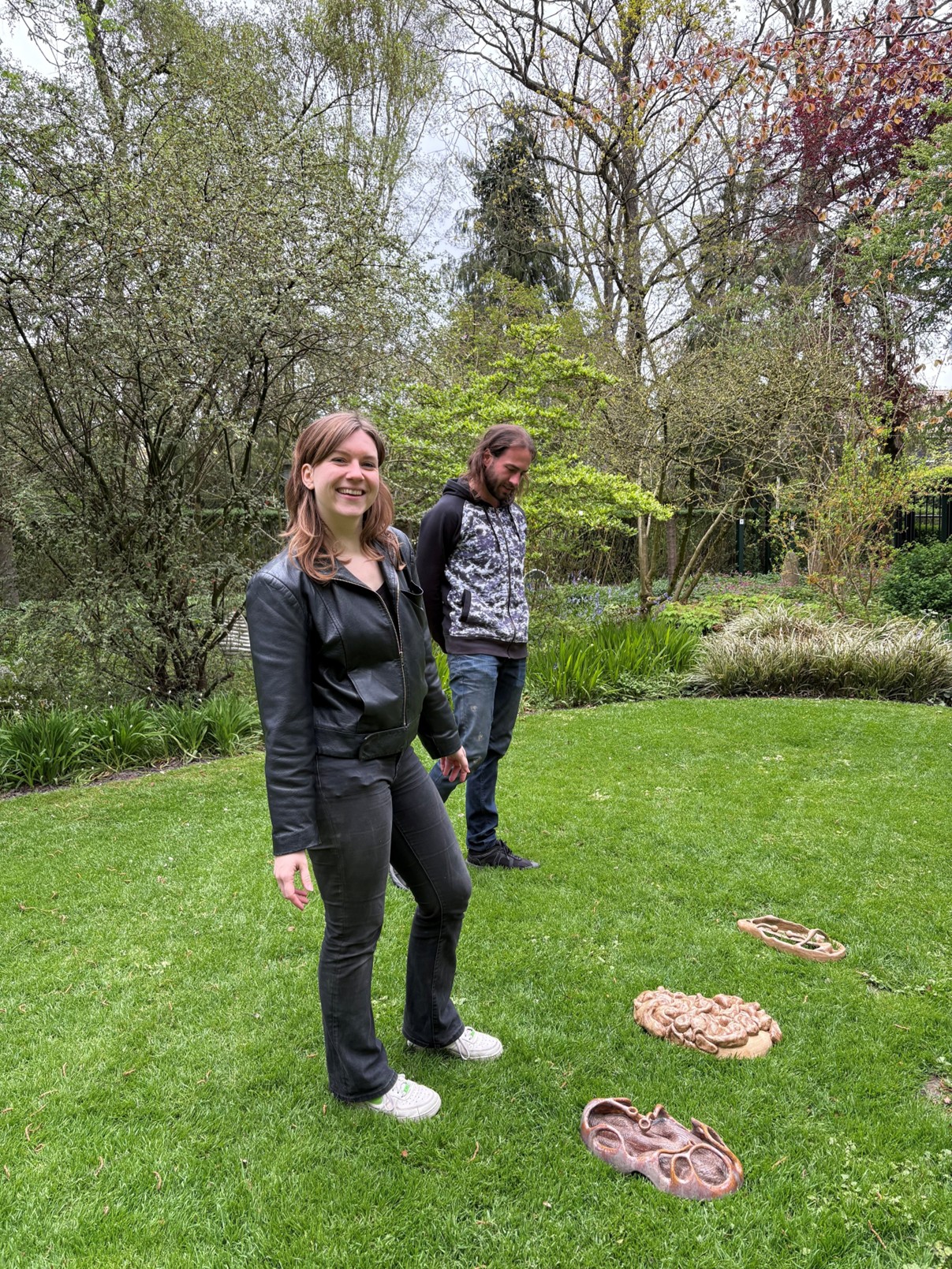
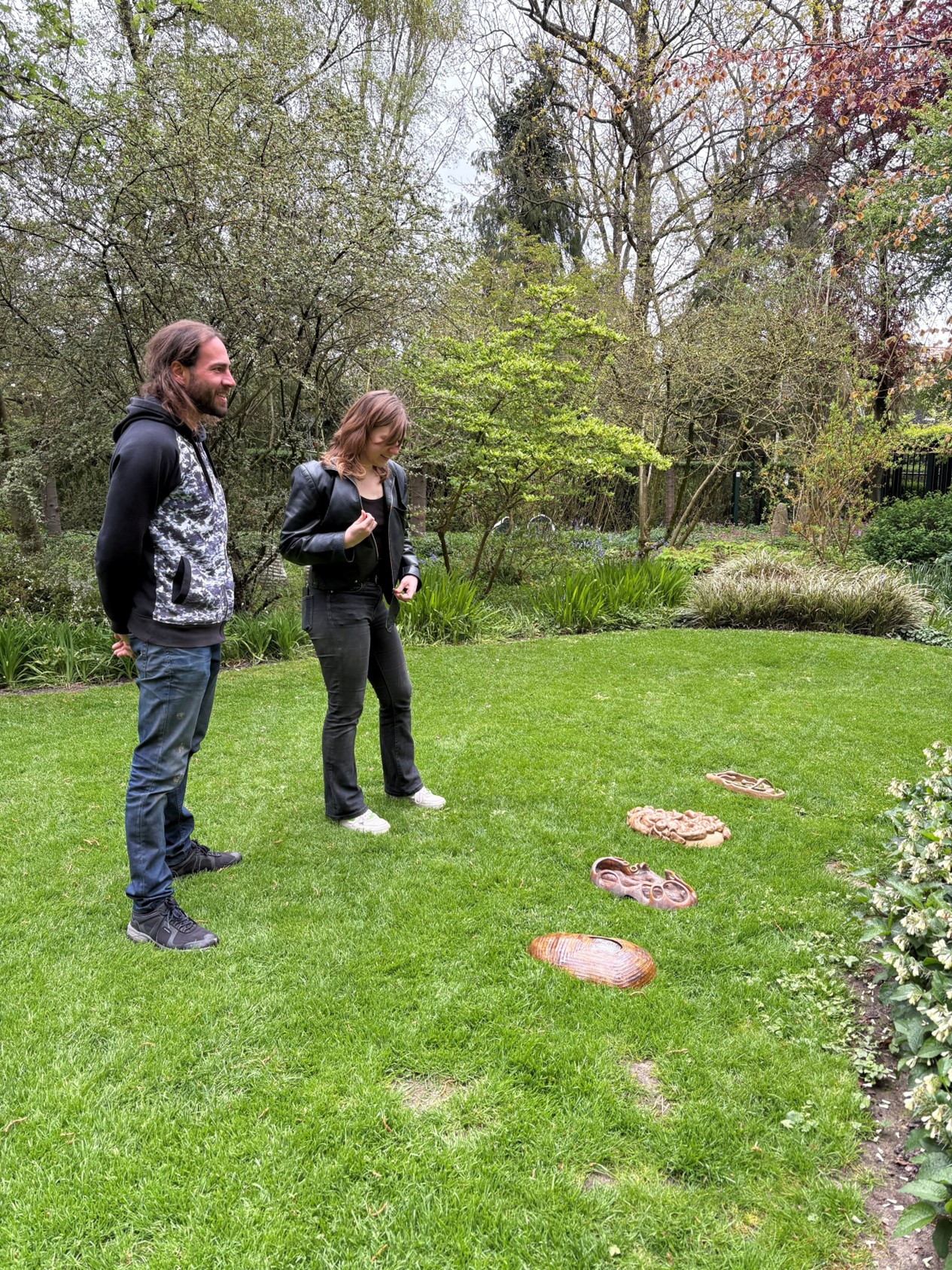
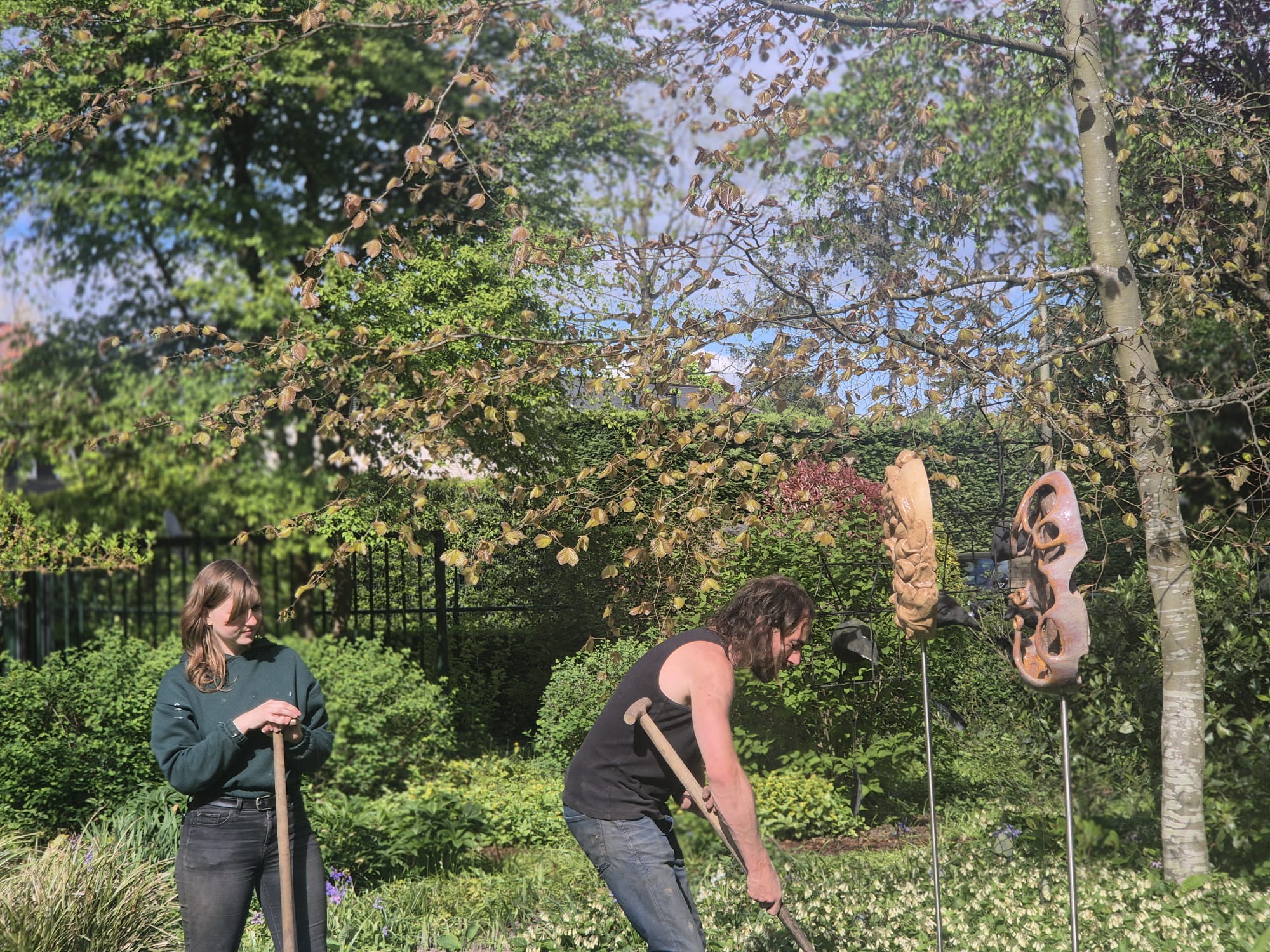
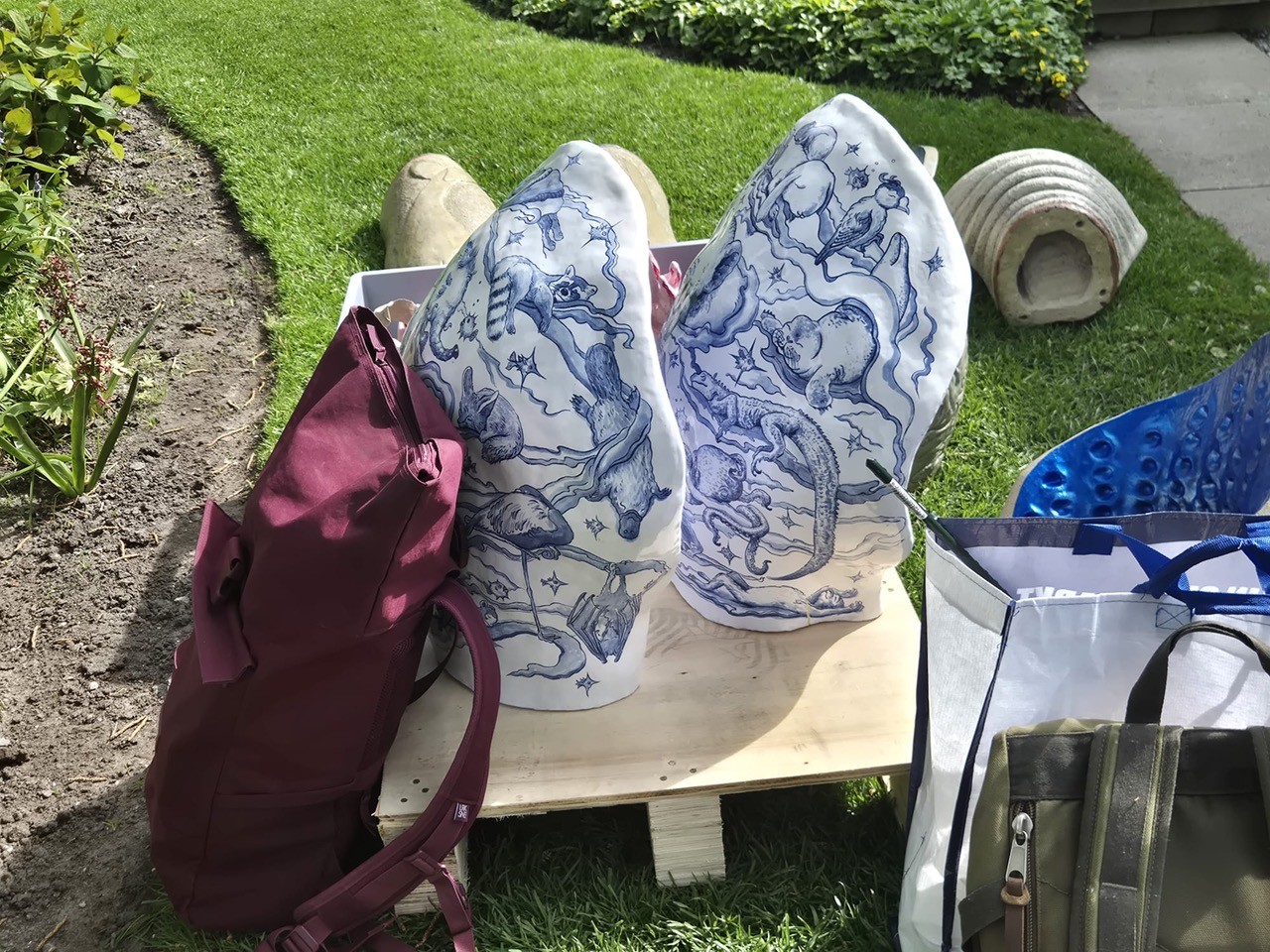
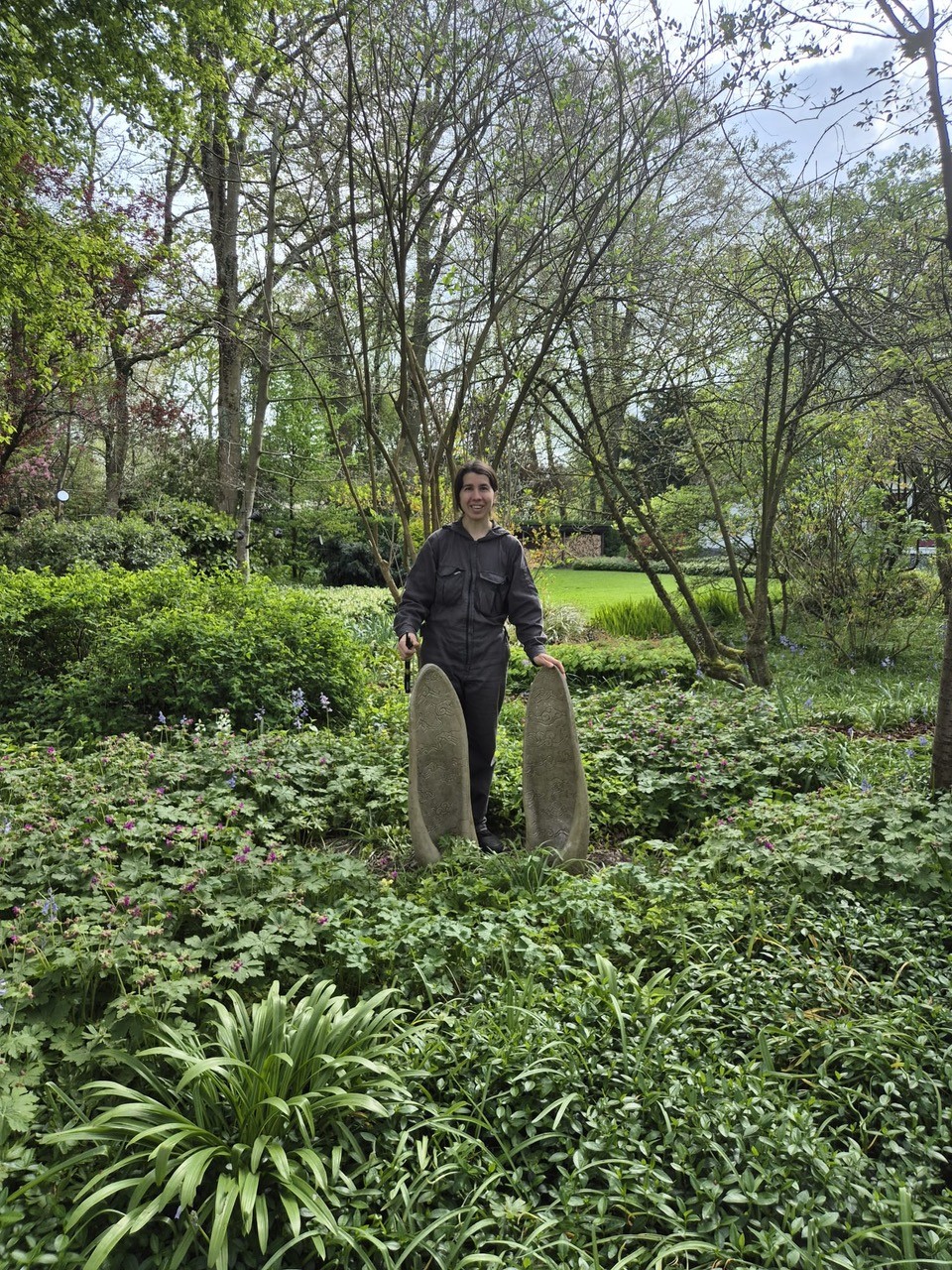
Voor de zomerexpositie van GB5 presenteren Teresa Hunyadi en Pepijn van den Nieuwendijk hun gezamenlijke sculpturenreeks Listening Ears: een serie keramische vormen die het luisteren zelf tastbaar maken. Verspreid door de tuin ontstaan paren van oorachtige objecten. Soms dierlijk, soms bijna abstract. Die samen een nieuw soort lichaam vormen: een lichaam dat niet namens de wereld hoort, maar met haar.
In aanloop naar de tentoonstelling sprak curator en schrijver Joshua Miller met de kunstenaars over hun samenwerking, hun werkwijze en de verbeelding die aan de basis ligt van dit project.
Zie hieronder het interview:
What Language Does Grass Dream In? Conversations with Teresa Hunyadi and Pepijn van den Nieuwendijk
Joshua Miller
Delft, March 2026
Five years ago, I cut a photograph out of a Guardian weekend supplement and stuck it in my scrapbook. It showed a mural of four sleeping black rabbits. I always wanted to integrate it into something, perhaps a collage, or a poem to surround them with tender words. There was something compelling about their shared sleep. The mural carried a pleasantly heavy sense of peace, as if the rabbits slept on my chest. It made me feel as if the earth was holding its breath.
Sleeping animals activate a tender curiosity. I wondered what the rabbits were dreaming about, how the life of a rabbit might be remixed in its subconscious and show itself in sleep. Whether the four in the mural dreamt was never in doubt.
Perhaps it is this kind of curiosity, soft, speculative, unanswerable, from which Listening Ears grew. This collaborative sculpture series by Teresa Hunyadi and Pepijn van den Nieuwendijk playfully asks: does the world dreams? If so, what does it dream of? What do rabbits dream of? What about the grass they run through when they wake? Does grass dream? A playful line of imaginative inquiry emerges from the idea of listening carefully to the world around us.
Teresa and Pepijn conducted their inquiry by creating forms that materialise the act of listening — great clay ears inscribed with patterns and living forms to tell stories that don’t begin with us. Something beautiful surfaces: a playful cosmology, the world around us imagined as an active, enthusiastic thing, full of life and always engaged in transformation and flux.
Together with the garden of GB5, in which they are placed, the ears form a shared listening body that does not claim to hear on behalf of the world but instead patiently listens with it. Teresa and Pepijn left room for uncertainty, even smallness; for our place in a natural chorus.
I sat down with Teresa and Pepijn to discuss Listening Ears.
JM Pepijn, Teresa, how are you doing?
PN Great. It’s a really enjoyable collaboration we are doing. We’ve been working since December 2025 and I am very much inspired. Working together is a different way of working. I love it but I get a little out of my comfort zone.
JM What is your comfort zone?
PN I am used to working quite freely – I might make a dragon or a dodo and resolve things later with paint. But here, Teresa’s focus on form has really influenced me. It made me pay closer attention to the sculptural qualities themselves rather than relying on surface painting.
TH Whereas in my practice I don’t paint much, so the form has to stand on its own. The glazing stage is still ahead of us and will shift things in somewhat unpredictable ways. It’s exciting but also a bit daunting, so it’s really good to be around Pepijn’s ease and experience.
JM Have you decided on glazes yet?
PN We will mainly use different glazes than I usually use. Teresa and I share an interest in celadons and wood ash glazes.
TH In the tests we made you see that deeper lines come out lighter and sometimes darker, depending on how transparent or opaque the glaze turns out.
JM Teresa – how are you doing?
TH Also very good. Bouncing ideas off each other has been really enjoyable. We get so caught up that we hardly take breaks — sometimes working until five in the morning – oh, let’s do these sketches, oh, remember that! Our interests really meet, and that’s when it feels a bit magical, and maybe a little endless.
PN We’re on a tight timeline — about three months: shaping, testing, finishing before the April exhibition set-up.
TH On top of that, every pair of objects has led to a different method in building them up – while working we’re inventing as we go.
JM Can you tell me more about the items I see lying here on the table?
PN These are objects and books with images that inspire us – a collection of growing unexpected references we find.
TH For example these ones here: you have lunch, you eat an avocado, the peel stays around, dries and then you’re like, oh, look at this! JM So this avocado peel directly influenced one of the pieces? TH Yes, there is one pair we actually call Avocado when we talk about it! (smile)
JM I can really see the resemblance!
PN When working together and you see something, you get inspired. Ideas emerge very naturally in this collaboration.
JM I had a couple of questions that lean on the listening aspect – part of your title of these pieces – Can you tell me more about it?
TH We are building pairs of ears, animal-inspired ears. Each suggests a different narrative related to listening — how we perceive the world and how the world might perceive itself.
PN Each pair is very different with the kind of story it tells.
JM It seems to me that, conceptually speaking, the two of you are in the business of creating contact zones? Deliberate ones, spaces of interaction of sorts.
TH That’s a nice way to put it. It’s a bit poetic maybe — a contact zone; when things come into contact without intention or meaning. Like, imagining walking on grass, there’s an exchange happening before you even notice it. The grass responds, the body responds. It raises the question: what’s being experienced on both ends? From my perspective, I try to pay attention a bit more consciously — attention, in a way, allows for more space.
PN There is always a response. And listening is something we often lack. For animals it’s a big part of survival.
TH We don’t have much access to other perspectives, so imagination becomes important. At the same time, the work isn’t overly serious. There’s a playful, surreal quality — flying hippos, for instance.
PN It’s about making space for that imagination. Often people have headphones on all the time. One never listens to just the silence of the landscape. And maybe that’s where the flying hippo comes in – you hear something magical, or something you usually don’t hear because we don’t listen carefully.
TH Maybe this work is also about acknowledging that there are multiple realities the whole time. Watching animals moving their ears, imagining my ears becoming their ears, is an inspiring game to play.
PN We also included the image of whales in one of the pairs — thinking about how they communicate through sound. I was reading Moby Dick at the time. The idea of resonance and shared language is quite beautiful, almost magical.
TH On these ears, one whale is swimming up and one down. Just considering that somewhere, right now, whales are ‘coasting between continents’ — it shifts your perspective. I came across a poem by Billy Collins called ‘Whale Day’ at that time.
JM So the two of you are pulling influences from encounters in everyday life and doing this – kind of playful conjecture into the idea of multi-species dream-world like contact zone. What will happen when you put them outside — into the sculpture garden?
TH The placement is a big part of the work.
PN If you see two animal ears on the ground, you wonder where the body is. So the ground turns into the body a bit, and then you start asking what kind of body? What kind of creature? It’s not always clear what kind of animal we made. The rabbits are maybe the most direct.
TH In both of our works you find creatures. They keep coming back.
PN I like humour. (laughs)
PN It’s interesting, because Teresa comes up with ideas I would probably never do myself. Like the stripes on the back — I would never really make the decision to do them this way.
TH For me, stripes are fun. Our approaches do differ, which makes it interesting. But we can engage with each other’s visual language
happily — even when it’s not something we’d do individually.
PN And there’s a balance — we’re not overly protective, which is essential for collaboration. We trust each other.
TH For me, it’s quite unusual working like this. I don’t often let others intervene in my work. But here, because the project sits slightly outside our individual practices, there’s more freedom to experiment.
PN I think it’s very important to be very open to somebody else’s ideas and suggestions. Otherwise collaborations can be difficult.
JM It feels like a very intuitive pairing between you. Kind of a dream collab?
PN It feels good. We’ve been doing some really interesting things. For me it’s a busy time but very fruitful.
TH And practically, working together helps a lot — handling materials, building larger pieces. With four hands instead of two, or even six because we have a wonderful intern as well!
PN Yeah! Pavlos is very helpful. Things get a little bit bigger.
JM Where do you think this project might go? Are there any more stories waiting?
TH Oh we have a whole list — we could really continue this project!
PN We want to keep things open. The meanings and stories aren’t final. Like listening itself, the work leaves space for interpretation and continuity.
Listening Ears can be experienced at GB5, Rhoon from May 10 to September 6, 2026. https://www.gb5.nl/?p=3872
https://teresahunyadi.com/
https://pepijnvandennieuwendijk.com/
Joshua Miller is a curator and cultural journalist. He publishes independently at https://substack.com/@joshm

Hier tonen wij het werk die Rient Adrijan zal presenteren tijdens de zomerexpositie van 2026.
Rient ontving de stimuleringsprijs van de Fleur Groenendijk Foundation, waardoor wij in contact zijn gekomen met zijn bijzondere werk.


Artist statement
Adrian Kiss’ art practice has been rooted in an intuitive relationship with materials, treating them as a safe
space and forming the foundation of his artistic language. This familiar space has always invited him to
explore broader, more complex dynamics—a horizon he’s only recently had the courage to cross. In his
earlier work, Kiss struggled to translate his positionality and material intuition into larger narratives, often
compelling him to imagine himself burying his works for transformation: curing and aging. He began to
use this approach as a guiding methodology, to understand the performativity of materials, and the
transformative potential of forces, thus he began investigating how the non-living can act as a performer,
embodying time-based processes, under and beyond the influence of the human.
Bio
Adrian Kiss (b. 1990, Miercurea-Ciuc, RO) is an artist working between Rotterdam and Budapest. He
holds an MFA from the Piet Zwart Institute in Rotterdam (2025) and a BA from Central Saint Martins,
London. His large-scale textile-based installations have garnered international attention, including
inclusion in Vitamin T: Threads and Textiles in Contemporary Art (Phaidon, 2019).
He was awarded the Derkovits Scholarship (2021, 2022), nominated for the Leopold Bloom Art Award
(2025), shortlisted four times for the Esterházy Art Award, and preselected for the STRABAG Art Award
in 2021. Recent residencies include the Advanced Textile Program at the TextielMuseum, Tilburg (2025),
the Fleur Groenendijk Residency at Brutus, Rotterdam (2025), and Art in General, New York (2018).
His work has been exhibited across Europe and the US, including solo shows at VUNU Gallery (Košice,
2023), FUTURA (Prague, 2017), and Trafó Gallery (Budapest, 2015). Group exhibitions include BOZAR
(Brussels), Bunkier Sztuki (Krakow), Ludwig Museum (Budapest), Künstlerhaus (Graz), Centre d’art
Neuchâtel, the Contemporary Art Museum of Estonia (Tallinn), and the Hungarian National Gallery
(Budapest, 2025). In 2025, he presented a duo exhibition Restless Dislocations at the Ján Koniarek
Gallery (Trnava, SK) and received commissions from ATiiSSU, Seoul.
Short Work Description
This textile work is constructed from nine second-hand leather jackets. Each jacket was carefully taken
apart stitch by stitch, allowing for a slow, material engagement with the traces of previous use. The
process reveals a shared history between the garment and the body it once protected and accompanied.
Inside the linings, remnants were found—dust, dirt, and small forgotten objects—while the leather
surfaces carry visible wear. The material bears the marks of time, registering use, pressure, and aging.
The disassembled leather is reconfigured into a large-scale soft sculpture. Its form loosely recalls utilitarian
objects found in agricultural environments, suggesting functions of storage, support, or containment.
The patterning of the work is informed by close-up studies of clothing and fragments of the human body.
These details are enlarged and translated into new constructions, using leather that once functioned as a
second skin for others. Through this transformation, the work operates as a body in itself, a continuation
and rearticulation of accumulated histories.
Price: € 13500

Rient Adrijan zal tijdens de aankomende zomerexpositie zijn werk presenteren in de tuin van GB5.
GB5 brengt graag het werk onder de aandacht van Rient Adrijan (1997, Erp), een in Rotterdam werkende kunstenaar die zich beweegt op het snijvlak van glas, kleur, animatie en betekenis.
Vanuit zijn atelier in Rotterdam ontwikkelt Adrijan een veelzijdige praktijk waarin traditionele technieken zoals glas-in-lood samenkomen met hedendaagse vormen als animatie en lichtinstallaties. Zijn werk kenmerkt zich door een gelaagde benadering van licht en expressie, waarin abstractie en figuratie elkaar versterken en samen verhalen vertellen.
Met een achtergrond in animatie onderzoekt Adrijan hoe beweging vertaald kan worden naar glas. Dit resulteert in wat hij zelf omschrijft als “Lichtiek”: een vloeiende dans van kleur, transparantie en ritme. In deze werkwijze wordt glas niet benaderd als statisch materiaal, maar als een levend en dynamisch medium dat reageert op licht, ruimte en de aanwezigheid van de kijker.
Zijn werk is zowel experimenteel als maatschappelijk betrokken, en nodigt uit tot een andere manier van kijken. Door glas letterlijk te laten “spreken”, zoekt hij naar nieuwe vormen van verbeelding en betekenis.
Rient Adrijan studeerde aan SintLucas in Eindhoven (2013–2017) en vervolgde zijn opleiding aan de Willem de Kooning Academie (Audiovisual Design, 2017–2021). Naast autonoom werk realiseert hij ook opdrachten.